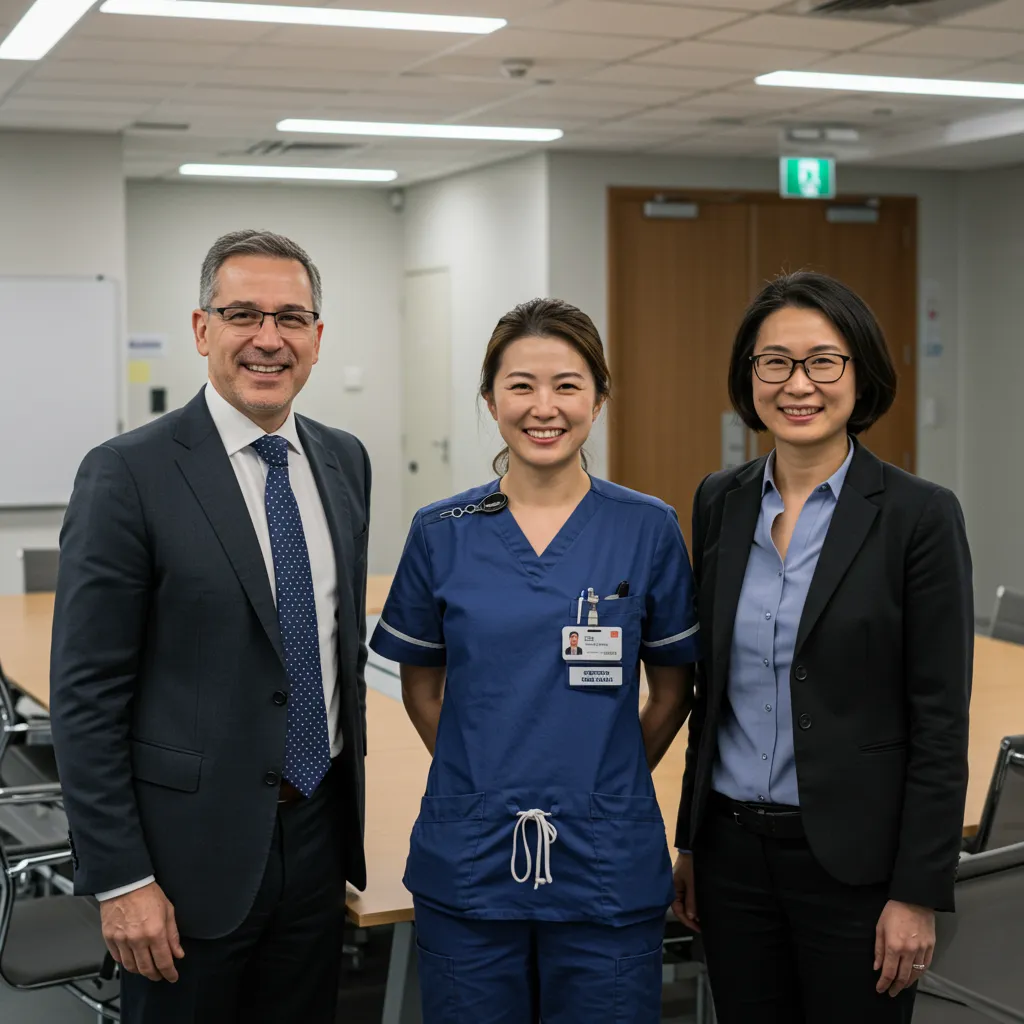
The Win-Win-Win Model: When Hospitals Staff and Vendors All Benefit
Most hospital uniform programs operate on a zero-sum assumption: to save money, someone has to lose.
Either the hospital pays too much, or the staff get subpar options, or the vendor margins get squeezed unsustainably.
But what if there's a better model?
After years of working on this problem, I've become convinced that the best uniform programs are win-win-win — structures where hospitals save money, staff get better service, and vendors build sustainable partnerships.
Here's how it works.
The Traditional Lose-Lose-Lose
First, let's acknowledge how most programs actually operate:
Hospitals "win" on price but lose on service: They negotiate the lowest possible per-item cost, then suffer poor vendor responsiveness, stockouts, and quality issues.
Staff "win" on choice but lose on support: They get an allowance and a vendor list, but no guidance, no tracking, and no one to call when things go wrong.
Vendors "win" the contract but lose on margin: They accept thin margins hoping for volume, then underinvest in service because the economics don't support it.
The result: a technically functioning program that frustrates everyone involved.
What Win-Win-Win Looks Like
For the hospital:
Lower total cost of ownership (not just per-item price)
Reduced administrative burden
Better compliance and consistency
Improved staff satisfaction (which affects retention)
Clear visibility into spending and usage
For staff:
Easy ordering process
Quality products that fit well and last
Clear information about allowances and eligibility
Fast resolution when issues arise
Feeling that their employer invested in doing this right
For vendors:
Predictable, sustainable business
Long-term partnership rather than annual rebidding
Fair margins that support good service
Opportunity to innovate and add value
Reference customer for other prospects
The Three Principles
Building a win-win-win model requires three shifts in thinking:
Principle 1: Optimize for total cost, not unit cost
The cheapest scrub isn't the cheapest scrub if it falls apart twice as fast, requires more administrative time to order, and creates staff complaints that HR has to field.
Win-win-win programs calculate total cost of ownership:
Product cost
Administrative labor to manage the program
Time cost to staff for ordering and issue resolution
Replacement costs due to quality issues
Intangible costs of staff frustration
When you optimize for total cost, you often find that paying slightly more for product and service reduces overall spend.
Principle 2: Create value before dividing it
Zero-sum negotiations focus on dividing a fixed pie. Win-win-win negotiations focus on growing the pie first.
How do you grow the pie?
Consolidate volume for better pricing (hospital wins)
Simplify ordering for lower service costs (vendor wins)
Improve experience for higher satisfaction (staff wins)
Commit to longer partnerships for investment justification (all win)
When you create value through better structure and process, there's more benefit to share.
Principle 3: Align incentives
Traditional programs create misaligned incentives:
Hospital wants low cost → pushes vendor on price → vendor cuts service
Vendor wants volume → oversells → staff get products they don't need
Staff wants flexibility → goes outside the program → hospital loses leverage
Win-win-win programs align incentives:
Hospital shares savings when vendor reduces total cost
Vendor earns bonuses for service quality metrics
Staff get better benefits for staying within the program
A Concrete Example: The Strategic Partnership Model
Here's a structure we've seen work:
Hospital commits to:
3-year exclusive partnership (no annual rebidding)
Consolidated purchasing across all departments
Streamlined approval process
Shared savings incentive (vendor keeps 20% of documented savings)
Vendor commits to:
10% discount off standard pricing (volume-based)
Dedicated account manager
48-hour fulfillment standard
Quarterly business reviews with improvement goals
Investment in technology integration
Staff receives:
Self-service ordering portal
Real-time allowance visibility
Expanded product selection
Faster delivery
Single point of contact for issues
In this model, the hospital gets better pricing AND service. The vendor gets predictable business AND fair margins. Staff get easier process AND better products.
Why This Isn't More Common
If win-win-win is so logical, why isn't it standard?
Procurement habits: Purchasing departments are trained to drive down unit cost. Total cost thinking requires different metrics.
Short-term focus: Annual budgeting and contracts discourage long-term partnership thinking.
Siloed decision-making: HR owns allowances, departments own ordering, finance owns budgets. No one owns the whole picture.
"That's how we've always done it": Changing established vendor relationships and processes requires effort and risk.
Breaking these patterns requires leadership commitment and a compelling case for change.
Building Your Case
If you want to propose a win-win-win restructuring, you need to:
1. Document current total cost
Include everything — product, labor, waste, staff time, hidden costs.
2. Quantify the opportunity
What could you save with better structure? What would staff satisfaction improvement be worth?
3. Design the new model
What commitments would you make? What would you ask of vendors? How would staff benefit?
4. Identify pilot opportunity
Can you test the model with one vendor or one department before full rollout?
The Bigger Idea
Win-win-win isn't just a uniform management philosophy. It's an operational philosophy.
Every vendor relationship, every internal process, every staff-facing system can be evaluated: Is this zero-sum or positive-sum? Are we fighting over value or creating it?
Uniform programs are a good place to start because they're contained, measurable, and visible. Get it right here, and you've built a template for broader operational excellence.
Start by understanding your current costs — then imagine what a win-win-win model could look like for your organization.
Super Hue is the Founder of Uniforms Logic and "The Chaos Eliminator" — helping mid-size hospitals transform uniform management from operational headache to strategic advantage.


